%20(1).png)
Digressing From the Traditional Path - The Startup Life with Jay Raval


Welcome back to the 180DC Pod - hope you have all survived mid-terms! Reaching the halfway point of the year, many of you may be considering your possible career paths. It is more important than ever to pause and consider all the options available to us.
This month, we sat down with Jay Raval, who left his coveted career in consulting at Oliver Wyman after only two years to pivot and build his own startup, Troopa, an AI-powered platform re-envisioning how groups design and plan travel.
How Jay’s Journey Started: Building The Resume
Starting off in 2018, undertaking a Bachelor of Commerce/Bachelor of Laws at the University of New South Wales, Jay initially thought he would enter the legal industry post-graduation. However, following advice by his brother, Jay decided to join 180DC as a project consultant in his second semester. In his three years there, he gained experience as a project leader, consulting director, and eventually became Vice President of Operations. It was here that he fostered his love for consulting and the satisfaction of delivering tangible impact for organisations.
Amidst all these, he gained experience in financial advisory in private equity, worked at Gallardian in sales consulting for startups, at Monitor Deloitte in strategy, and as a UNSW student ambassador. The plethora of experiences elevated his skillset and paved the path for a successful career.
The Realities of Consulting
“As soon as I joined 180DC, I realised what consulting actually was, and it gave me a really clear picture of what I enjoyed and what I did not… 180DC was definitely the reason that I decided that I wanted to go into consulting.”
Jay recalls his experiences in the consulting industry fondly, recalling the thrill of working collaboratively and iteratively with clients, similar to the framework 180DC offers in their project consulting cycles. Being mentored by partners and actively pressure testing solutions amidst a variety of different cases in aviation and private equity made the work exciting, rather than repetitive. He also appreciated the travel opportunities that consulting provided.
“There is not a lot of jobs that give you an opportunity like this, but it gets taxing very quickly… As someone straight out of university, it is a pretty cool experience.”
Despite the wins, Jay warns of the stressful and high-pressure nature of the industry, where you are often expected to work long hours and adapt to fast-paced environments.
The Difficult Decision
Two and a half years in, Jay was at a crossroads. He enjoyed what he was doing and the impact he was delivering in consulting, but he felt that it was not his true passion.
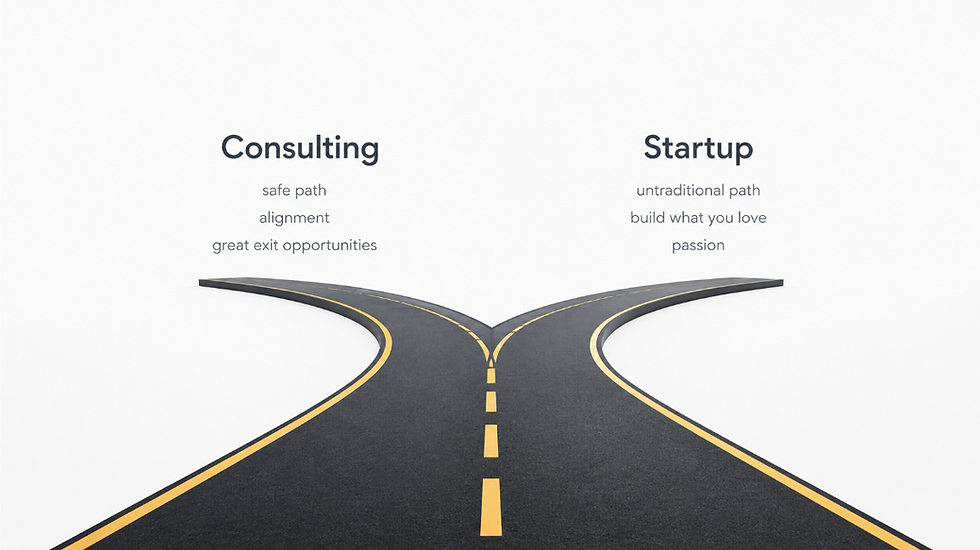
He knew he wanted to take a risk and pursue something he was passionate about.
So he left, choosing the non-traditional path.
Startup Life

Whilst startup life has more flexibility, Jay warns that the fast-paced nature of consulting does not die away; if anything, it is even more intense.

When asked if he believes his corporate career equipped him for his career in startup, he noted he gained the following transferable skills:
Storytelling: In consulting, generating solutions to client problems is only one phase of the process. Presenting the solution as clear, persuasive and actionable for clients is another key skill consultants must have to ensure the logic is understood. In the startup space, this skill is essential in translating the product’s messages, journey, goals and marketing.
Problem Solving: Consultants are often faced with ambiguous problems within high-pressure environments. This trains them to prioritise key pain points and translate them into optimal recommendations. This is an essential skill in the startup space as co-founders often face a number of problems and are required to use their intuition to prioritise the most important ones.
Prioritisation: Knowing how to prioritise the key issues, recommendations and questions is essential in consulting. This is equally important in the startup space, where you may have to juggle different domains, e.g., product, contracts and marketing, which is often difficult to grasp straight out of uni.
Connections: Although not a significant impact, Jay notes how many of his advisors are partners he worked with at Oliver Wyman. In addition, there are many networking and alumni events even after exiting, which can bring beneficial long-term connections.
Additionally, working in corporate for a few years put Jay in the financial position to live comfortably while his startup was in the build phase.
Final Remarks: Navigating Self-Doubt, Risk and Resilience
Choosing to pursue a startup is a big decision: not only do you have to consider the financial impacts, but the emotional factors. Although most of the time, startup co-founders have faith in the viability of their product, Jay remarks that often self-doubt can fade the optimism. In these cases, it is important to have resilience and avoid the pitfalls of fixating on perfectionism.
It is also important to pick a co-founder who complements your personality and work ethic well. (Fun Fact: Jay met his cofounder during his time in 180DC!)
“You will always have hiccups. And the people who make it work in the startup world are often the ones who are most resilient to those hiccups and can get through them.”
Jay notes that whether your venture works out or not, the experience is invaluable, and it can open the door to so many roles, whether it is in consulting, tech advisory, or other industries.


Comments